

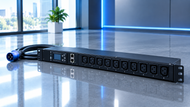
A server rack can look neatly organized from the front while its power setup becomes harder to manage behind the equipment. As more servers, storage systems and network switches are added IT teams have to account for available capacity, cable routing, circuit loading and future expansion. A Power Distribution Unit (PDU) provides a structured way to distribute electrical power to rack equipment instead of relying on scattered outlets or ordinary power strips. Basic PDUs focus on distribution, while advanced models can add metering, monitoring, alerts and remote outlet control. This guide explains what a PDU is, how it works, the main rack PDU types and what to check before deployment.
What Is a Power Distribution Unit (PDU)?
A Power Distribution Unit (PDU) receives electrical power from an upstream source and distributes it through several outlets to connected equipment. In a server room or data center, the incoming supply may come from utility power, a UPS or another facility power circuit. The PDU acts as the connection point between that supply and the servers, storage systems and networking devices installed in the rack.
A basic unit mostly distributes power. Depending on the model, an advanced PDU may also measure electrical load, provide network access, generate alerts or control individual outlets. A PDU is not a UPS: a UPS provides backup power, while a PDU distributes available power to connected equipment.
Rack PDU
A Rack PDU is designed for installation in server cabinets. Common formats include vertical 0U units and horizontal 1U or 2U models. A 0U PDU can use vertical space at the rear of a cabinet without taking up standard horizontal rack units, which can be useful in densely populated racks.
Data Center PDU
A Data Center PDU forms part of a wider power distribution design where rack density, monitoring, availability and capacity planning may be more demanding. Rack level PDUs distribute power close to the IT load, while upstream systems handle earlier stages of facility distribution. ISO/IEC 22237-3:2021 addresses power distribution in data centers and includes measurement of power consumption and power quality characteristics, along with addition into management tools.
How Does a PDU Work?
Power enters the PDU through its input connection and passes through the unit's internal distribution and protection components before reaching the output outlets. Servers, storage devices, network switches and other rack equipment then draw power from those outlets.
PDUs are available with different voltage ratings, current capacities, phase configurations, input connectors and outlet types. Some models also include circuit protection for individual branches or sections. For that reason, outlet count alone does not determine whether a PDU is suitable. IT teams also need to consider the expected load, the supplying circuit, phase balance where applicable and planned expansion.
Network Rack PDU
A Network Rack PDU adds network based management to rack power distribution. Depending on the model, administrators may be able to view electrical measurements, receive alerts and control outlets remotely through a web interface or management platform. SNMP and other network management methods may be available, but the supported protocols vary by product.
What Is a Rack Mount PDU?
A rack mount PDU is purpose built for installation inside a server cabinet. Its basic components include an input connection, internal distribution circuitry, protection components were provided and many output outlets.
Common outlet formats include IEC C13, IEC C19 and various NEMA configurations. Input connections and electrical ratings also vary, so voltage, amperage, phase, connector type, outlet count, cable length and mounting format should all match the rack's electrical design.
Hot-Swappable PDU
A hot-swappable PDU generally refers to a design where a specific component can be replaced or upgraded without interrupting connected equipment. In some platforms, for example, communication or management modules may be designed for serviceability without shutting down the rack. The exact component covered by the hot swap function should always be confirmed for the specific model.
Automatic Transfer Switch (ATS) PDU
An Automatic Transfer Switch (ATS) PDU accepts two power sources and can transfer compatible equipment from a primary source to a secondary source when the chosen input becomes unavailable. This can provide an alternative power path for suitable single corded equipment.
An ATS PDU does not generate backup power. Its usefulness depends on having suitable input sources and an appropriately designed power architecture.
Types of Rack Mount PDUs
Rack mount PDU models range from straightforward power only units to advanced platforms with measurement, communication and outlet control features. Manufacturers do not always use identical terminology, so the actual specification matters more than the product label. Eaton, for example, distinguishes between basic, metered input, metered outlet, switched and managed rack PDU designs.
Basic PDU
A Basic PDU provides straightforward power distribution without built in network monitoring or intelligent controls. It can suit a stable rack where the main requirement is organized access to electrical power and the team already has sufficient visibility into the load through other systems.
Metered PDU
A Metered PDU adds electrical measurement. Depending on the design, readings may be available at the input, branch or outlet level. This information can help administrators understand current demand before installing extra equipment or moving loads.
Local Metered PDU
A Local Metered PDU provides load information directly on the unit, typically through a local display or meter. This can be practical in a single rack or smaller server room where technicians regularly have physical access to the equipment.
Monitored PDU
A Monitored PDU makes power information available remotely through a network connection. Depending on the model, administrators may be able to monitor current, voltage, power, energy usage or alarm conditions. For multi rack environments, remote visibility can reduce the need for routine physical checks.
Switched PDU
A Switched PDU adds remote outlet control. Depending on the platform, an authorized administrator can switch an outlet off or-on-or power cycle connected equipment. This can be useful for remote sites and edge placements were dispatching a technician to restart an individual device is inconvenient.
Intelligent PDU
An Intelligent PDU combines advanced monitoring and management capabilities. Depending on the model, this may include outlet level measurements, alarms, environmental monitoring, remote switching, APIs and addition with infrastructure management software.
The main working advantage is better visibility into actual rack conditions. Measured data can support capacity planning and troubleshooting instead of relying only on equipment nameplates. This becomes increasingly relevant in higher density environments where rack power demand can change significantly with workload.
Smart PDU
A Smart PDU usually refers to a network connected unit with more monitoring or management capability than a basic model. Because manufacturers use the term smart differently, buyers should check the exact monitoring, alerting, switching and additional features rather than relying on the label alone.
Network Switch PDU Units
A PDU and a network switch perform different jobs. The PDU handles electrical distribution, while the network switch handles data traffic. Both may be installed in the same rack especially in compact server rooms and edge environments, but they should not be treated as a combined device.
Difference Between Basic and Intelligent PDU Operation
The difference between basic and intelligent PDU processes mostly comes down to visibility and control. A basic PDU distributes power but normally provides little operational data. An intelligent model can collect electrical information and depending on the platform, provide alerts, detailed monitoring, outlet control or software integration.
This becomes more useful when equipment loads change over time. Virtualization hosts may draw different amounts of power as utilization changes, while storage heavy workloads or high density computing systems can create different demand patterns. Real measurements give system administrators a better basis for capacity planning than assumptions alone.
Intelligent PDUs
An intelligent PDU can turn rack level measurements into useful working information. Depending on the platform, power data can support alerts, anomaly detection, capacity planning and remote management. In high density AI environments, more detailed power monitoring can help teams understand changing rack demand and manage infrastructure more effectively.
Power Efficiency and Monitoring in the Modern Rack
A PDU does not directly reduce the electricity consumed by connected equipment. Its main contribution is visibility into the power being used. Metering can help teams identify uneven phase loading, understand actual rack demand, monitor remaining capacity and investigate unusual consumption.
Power measurement is also part of recognized data center infrastructure practice. ISO/IEC 22237-3:2021 includes requirements and recommendations related to measuring power consumption and power quality characteristics at points along the distribution system and integrating those measurements into management tools.
That information can support capacity planning and energy management programs. Where an organization tracks energy or sustainability metrics, measured data can also provide a stronger basis for reporting than estimates alone.
Selecting the Right PDU: Decision Framework
Start with the electrical load rather than the outlet count. Estimate the expected equipment demand, check the supplying circuit and maintain suitable headroom for normal variation and future expansion. There is no universal percentage that replaces applicable electrical requirements, site conditions or manufacturer specifications.
Next, select the required management level. A Basic PDU may be sufficient for a straightforward rack. Metered and monitored models add visibility, while switched and intelligent units provide greater levels of remote control and management.
Physical compatibility is equally important. Check the required 0U, 1U or 2U mounting format, input connector, voltage, amperage, phase configuration, outlet type, cable length and available rack space. Finally, verify the applicable certifications and approvals for the exact model and installation market.
PDU Innovation: What's Changing
Modern PDUs are becoming part of wider software managed infrastructure. Network connectivity, outlet level data, remote switching, alarms and environmental monitoring are already available on advanced platforms.
Higher density AI infrastructure is also increasing interest in detailed power monitoring and predictive analysis. AI assisted load forecasting and anomaly detection are emerging areas, although the available capabilities depend on the management platform and product.
Cloud based management can make distributed racks easier to monitor, while modular designs may allow selected communication or metering components to be replaced or upgraded. HVDC and 380V DC architectures are also being explored for high density data center environments, but these approaches involve broader facility level electrical changes rather than a simple replacement of a conventional AC rack PDU.
Conclusion
A Power Distribution Unit (PDU) provides a structured connection between an electrical source and the equipment installed in a rack. Basic PDUs focus on distribution, while metered, monitored, switched and intelligent models add different levels of visibility and control.
For IT and procurement teams, the decision should go beyond outlet count. Electrical capacity, rack format, connectors, monitoring requirements, redundancy, expansion plans and verified certifications all need to match the placement.
A PDU is also different from a PC's Power Supply Unit (PSU). A PSU converts and regulates power for components inside a computer, while a PDU distributes available electrical power to rack equipment. For readers planning a desktop build, see How to Pick the Right Power Supply Unit In 2026: for Your PC Build to learn more about PC power supplies.
CTS Point lists PDU products for different rack and infrastructure requirements. For bulk orders, buyers should verify the exact model's electrical specifications, compatibility, certifications and technical documentation before deployment.
Frequently Asked Questions
A: A typical PDU includes an input connection, internal distribution circuitry, protective components where provided and multiple output outlets. Advanced models may also include metering, network interfaces, outlet switching and environmental sensor connections.
A: An intelligent PDU distributes electrical power while collecting power related data and making it available through a management interface. Depending on the model, it may also provide alerts, outlet level monitoring, remote switching and software integration.
A: A metered PDU uses electrical measurement circuitry to track parameters such as current and depending on the model, voltage, power or energy consumption. Readings may be displayed locally or made available through a network connection.
A: A PDU does not directly reduce equipment power consumption. However, monitoring data can help teams balance loads, plan capacity, identify unusual usage and make more informed energy management decisions.
A: There is no single PDU type for every data center. The suitable option depends on electrical load, rack density, redundancy, monitoring requirements, remote control needs, outlet configuration and the current management infrastructure.
A: Certification depends on the exact PDU model and destination market. Bulk buyers should verify the applicable certifications, approvals and technical documentation for the specific product before installation.