

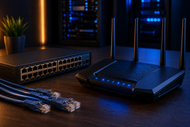
Enterprise networks used to run on manual rules. An engineer set the routing policies, watched the dashboards, and fixed problems after users complained. That model is fading fast.
In 2026, AI sits inside the network itself, and bridges and routers now learn from traffic instead of waiting for instructions. An AI-powered router studies how data flows through the business and adjusts paths on its own.
A smart bridge watches local segments and keeps internal traffic clean without anyone touching a config file.
For companies adding users, sites, and cloud apps every quarter, this shift changes what their networking devices can do and how much attention they demand.
Understanding AI-Powered Bridges and Routers
AI-powered bridges and routers are standard networking devices with machine learning built into how they forward traffic.
The hardware job stays the same. Bridges in computer networking still connect and filter local segments, and routers in computer networking still move packets between separate networks. What changes is the decision-making layer on top.
An AI-powered bridge learns normal traffic patterns inside a segment. When something unusual appears, like a device flooding the network or a loop forming, it reacts before the problem spreads. An AI-powered router goes further.
It tracks link quality, application demand, and time-of-day patterns, then picks paths based on live conditions rather than static rules.
One quick note for accuracy: in 2026, most bridging happens inside switches, since a modern switch is a multiport bridge. The AI features apply the same way across both.
AI in Modern Enterprise Networking
AI now handles work that used to eat entire IT shifts. Platforms like Juniper Mist, Cisco Catalyst Center, and HPE Aruba Central use machine learning to baseline what "healthy" looks like on a network, then flag anything that drifts from it.
This approach goes by the name AIOps, and it has moved from marketing talk to daily practice in enterprise IT.
The practical wins are easy to name. Configuration errors get caught before they take a site down. Slow Wi-Fi gets traced to a specific access point or a bad cable run in minutes, not days. Voice and video calls get priority automatically because the system recognizes the application, not just the port number.
Networking teams spend less time firefighting and more time planning, which is exactly where their hours should go.
AI-Driven Bridges and Routers for Scalable Enterprise Networks
Growth is where AI-driven bridges and routers earn their keep. A company running 200 devices can survive on manual management.
A company running 5,000 devices across four cities cannot. Every new user, IoT sensor, camera, and cloud connection adds traffic, and someone has to decide how all of it moves.
AI takes over that decision load. Smart routers spread traffic across links so no single path chokes at peak hours. Bridging intelligence keeps new segments organized as departments expand.
When a branch office opens, cloud-managed AI systems push a working configuration to the new hardware in minutes, a process the industry calls zero-touch provisioning.
The network absorbs growth instead of buckling under it, and enterprise networking bridges and enterprise networking routers stay ahead of demand rather than chasing it.
How AI Improves Bridges and Routers Performance in Business Networks
Performance gains from AI show up in three places. First, traffic management. AI-powered routers study flow patterns and steer heavy transfers away from paths carrying live video calls.
SD-WAN systems do this across broadband, fiber, and LTE links at once, moving each application to the connection that suits it best at that moment.
Second, faster problem response. Traditional monitoring tells you something broke. AI-based monitoring tells you something is about to break.
Rising error rates on a link, a slowly failing optic, memory creeping up on a router, all of these get flagged early so teams fix them during a maintenance window instead of during a Monday morning outage.
Third, cleaner local traffic. Smart bridging keeps chatter contained within segments, so file-heavy departments never slow down the rest of the building. Users feel the result as a network that simply works.
Enterprise Networking Routers and Bridges in Modern Infrastructure
Modern enterprise infrastructure is spread across offices, data centers, and multiple clouds, and bridges and routers hold it together.
Edge routers connect headquarters to the internet. Branch routers link remote sites over secure tunnels. Data center routers carry east-west traffic between servers and storage at speeds that would have sounded absurd five years ago.
AI matters here because this spread creates too many moving parts for humans to track alone. Cloud-based communication platforms, hybrid workers, and SaaS tools all depend on stable routing around the clock.
AI-assisted systems watch these paths constantly, reroute around trouble, and spot security anomalies like a device suddenly talking to an unknown server. Stability stops being luck and becomes a managed outcome.
Router Chassis & Modules in AI Networking Systems
A router chassis is the frame that houses the routing engine, power supplies, and open expansion slots.
Modules are the cards that slide into those slots to add ports, speed, or processing power. This design has always been about flexibility, and AI gives it a new job.
AI features need horsepower. Telemetry collection, flow analysis, and on-box analytics all consume compute, and chassis-based routers supply it through dedicated modules instead of forcing a full hardware replacement.
An enterprise moving to 100G or 400G links in its core swaps line cards rather than the whole unit. Redundant supervisors and power supplies keep the AI brain running even when a component fails.
For data centers and large campuses handling heavy traffic loads, router chassis and modules remain the most practical way to grow capability year after year.
Challenges of AI-Based Bridges and Routers
The honest picture includes real friction. AI-capable networking hardware and its licensing cost more than basic gear, and the subscription model behind most AI management platforms adds a recurring bill that smaller IT budgets feel. Integration is the second hurdle.
Mixing AI-driven systems with older networking infrastructure gets messy, since legacy devices rarely produce the telemetry the AI needs to learn from.
There's also the trust question. AI recommendations still need human review, because a wrong automated change can cause an outage as easily as a wrong manual one.
And these systems demand continuous updates and monitoring to stay accurate. None of this cancels the value. It just means adoption works best in phases, starting where the pain is loudest.
Future of AI-Powered Routers and Bridges
The direction for the rest of 2026 and beyond is clear. Networking devices are becoming self-learning, tuning their own performance from experience rather than fixed thresholds.
Intent-based networking keeps maturing, where admins state the outcome they want and the system builds the configuration to match.
Cloud-managed AI platforms will control more of the enterprise edge, letting one team run hundreds of sites from a single dashboard. Traffic prediction will keep improving, so networks pre-position capacity before demand spikes hit.
Smarter devices still need a solid foundation underneath them, and that starts with getting the basics of business connectivity right. Our Guide To The Importance Of Reliable Computer Networking For Growing Businesses explains why dependable networking is the base every growing company builds on before adding advanced technology on top.
Conclusion
AI has turned bridges and routers from passive traffic movers into active decision-makers. They learn, predict, and self-correct, and enterprises that adopt them get faster networks with fewer surprises.
The technology has its costs and complexity, but the trade favors adoption more strongly every year. Build the foundation well, add intelligence in stages, and the network stops being a bottleneck for good.
Frequently Asked Questions
A: They're networking devices with machine learning added to their traffic decisions. AI-powered bridges keep local segments clean by learning normal patterns, while AI-powered routers pick data paths based on live network conditions instead of fixed rules.
A: AI automates configuration, detects faults before they cause outages, and manages traffic in real time. Enterprises get networks that run themselves for routine work, which frees IT teams for planning and growth projects.
A: They monitor every link constantly, steer applications to the best available path, and give priority to time-sensitive traffic like voice and video. Congestion drops and users get consistent speed even at peak hours.
A: AI acts as the analysis and automation layer across the whole network. It baselines healthy behavior, flags anything abnormal, predicts hardware failures, and pushes configurations at scale across offices, data centers, and cloud connections.
A: Smart routers spread load across multiple links, predict demand patterns from history, and reroute flows the moment a path degrades. As traffic grows, they balance it automatically instead of letting one connection saturate.
A: Yes. AI-based systems learn what normal device behavior looks like, so unusual activity, like a workstation contacting an unknown server or sudden data spikes, gets flagged fast. That early detection shortens response time against threats.